
Proprietary Blends
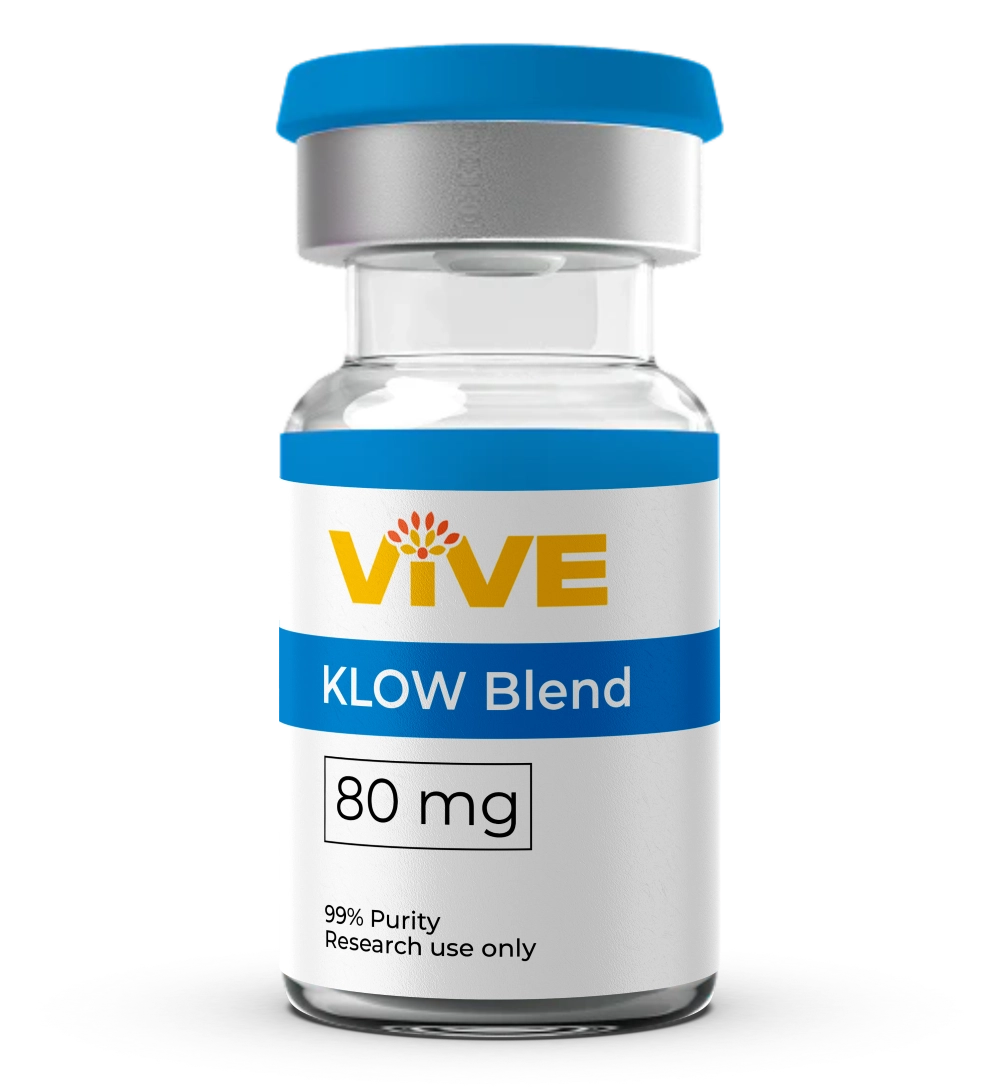
KLOW Blend
Research Use OnlyThese products are sold strictly for laboratory and research use only and are not approved for human consumption, diagnosis, or therapeutic treatment. Not for human or veterinary use. These statements have not been evaluated by the Food and Drug Administration, and nothing on this page constitutes medical advice or a health claim.
- Size
- Default
Specifications
KLOW Blend Technical Profile
OVERVIEW
What Is KLOW Blend?
KLOW Blend is a multi-peptide research formulation combining four well-characterized bioactive peptides: GHK-Cu (copper tripeptide-1), BPC-157 (gastric pentadecapeptide), KPV (Lys-Pro-Val), and TB-500 (Thymosin Beta-4 fragment). The formulation is designed for in vitro and preclinical research applications exploring anti-inflammatory signaling, tissue repair mechanisms, and regenerative pathways across multiple tissue types.
Each component in the KLOW peptide blend carries an independently established research profile. Together, they represent a convergent approach to studying multi-pathway repair biology within a single formulation, making KLOW Blend a practical tool for researchers investigating overlapping recovery and regeneration mechanisms that single-peptide preparations cannot address in one study design.
- 01
Anti-Inflammatory Peptide Blend
KLOW Blend pairs KPV and GHK-Cu, both studied for their capacity to modulate pro-inflammatory cytokine activity, alongside BPC-157 and TB-500, which have been independently investigated for their roles in tissue recovery signaling. The co-formulation supports research into how these anti-inflammatory and repair signals interact at the cellular level.
- 02
Tissue Repair Peptide Research
BPC-157 and TB-500 are individually among the most-studied peptides in connective tissue and musculoskeletal repair research. Their inclusion in the KLOW blend alongside GHK-Cu and KPV supports studies targeting multiple repair pathways simultaneously, enabling more comprehensive preclinical models than single-agent designs permit.
- 03
Regenerative Peptide Blend Research
GHK-Cu has a robust literature base spanning wound healing, collagen synthesis, and antioxidant activity. Paired with KPV's well-documented capacity to suppress NF-kB-driven inflammation, and the repair signaling of BPC-157 and TB-500, KLOW Blend enables regenerative peptide blend research across several tissue and cell model types.
RESEARCH
KLOW Blend Mechanism of Action in Research
KLOW Blend is formulated to engage at least four distinct but complementary biological pathways studied in the context of inflammation modulation and tissue repair. BPC-157 research centers on angiogenesis support and growth factor receptor upregulation in mucosal, tendon, and ligament models. TB-500 studies focus on actin sequestration, reduced inflammatory signaling, and enhanced endothelial and epithelial cell migration. GHK-Cu research documents copper-mediated induction of extracellular matrix remodeling enzymes, collagen synthesis stimulation, and antioxidant gene expression. KPV, the C-terminal tripeptide of alpha-MSH, has been studied as an anti-inflammatory tripeptide that interacts with melanocortin receptors expressed on immune cells and intestinal epithelium. Together, these four components create a recovery peptide stack research formulation with multi-pathway coverage not available from any single peptide.
BPC-157, Tissue Recovery Pathway
BPC-157 (gastric pentadecapeptide) has been studied for its interaction with growth hormone receptor pathways and its capacity to upregulate VEGF expression in preclinical wound and injury models. In vitro and animal studies suggest roles in tendon-to-bone healing, intestinal mucosal repair, and ligament recovery, with the nitric oxide system proposed as a key mediator.
TB-500, Actin Sequestration & Cell Migration
TB-500, the synthetic fragment of Thymosin Beta-4, is studied primarily for its actin-binding properties. Research indicates roles in reducing acute inflammatory signaling, promoting endothelial and epithelial cell migration, and supporting tissue recovery in skeletal muscle, cardiac, and corneal models. Its low molecular weight supports distribution throughout tissue compartments in animal studies.
GHK-Cu, Copper-Mediated Regeneration
GHK-Cu (copper tripeptide-1) is among the most extensively studied copper-binding peptides in regenerative research. Preclinical studies document stimulation of collagen and glycosaminoglycan synthesis, upregulation of antioxidant enzymes including superoxide dismutase, and activation of matrix metalloproteinase pathways involved in tissue remodeling and scar resolution.
KPV, Anti-Inflammatory Tripeptide
KPV (Lys-Pro-Val) is the C-terminal tripeptide of alpha-MSH. Research in cell and animal models demonstrates its capacity to suppress NF-kB activation, reduce pro-inflammatory cytokine release including IL-1b, TNF-alpha, and IL-6, and interact with melanocortin receptors on immune and intestinal epithelial cells. Preclinical colitis models have been a primary area of KPV investigation.
COMPARISON
KLOW Blend vs Single-Peptide Recovery Research
KLOW Blend
Single-peptide recovery research provides depth of mechanistic understanding for a given pathway but does not capture how overlapping signals interact in complex tissue repair scenarios. BPC-157, TB-500, GHK-Cu, and KPV each address distinct molecular targets, yet their downstream effects converge on inflammation resolution, extracellular matrix remodeling, and tissue regeneration. Studying them in isolation leaves combinatorial dynamics and potential synergistic signaling patterns unexplored, which is a meaningful limitation when the research question involves multi-tissue or systemic repair contexts.
Single-Peptide Recovery Research
The KLOW blend approach enables preclinical researchers to assess how simultaneous engagement of multiple repair and anti-inflammatory pathways behaves in model systems. This is particularly relevant for research contexts where single-target interventions have produced partial or pathway-limited effects. By combining a BPC-157 TB-500 GHK-Cu KPV blend into a single formulation, KLOW Blend simplifies study design, reduces the compounding variables introduced by separate peptide dosing across different timepoints, and allows researchers to observe the integrated response profile of four well-studied bioactive peptides acting concurrently.
RESEARCH STUDIES
KLOW Blend Components in Published Research
The individual components of the KLOW peptide blend each carry substantial published research histories spanning decades of preclinical and in vitro investigation. The summaries below reflect findings from animal and cell model studies and are provided for informational context only. They do not constitute clinical evidence of efficacy or safety in humans, and all reference to biological activity pertains strictly to preclinical research settings.
BPC-157 Tissue Repair Studies
Published preclinical studies on BPC-157 have examined tendon-to-bone healing, intestinal anastomosis recovery, and musculoskeletal injury models in rodents. Research has documented interaction with the nitric oxide system, VEGF upregulation, and fibroblast proliferation as proposed mechanisms underlying observed repair activity. Peer-reviewed animal studies have been published across gastroenterology, orthopedics, and wound biology literature since the 1990s.
TB-500 Connective Tissue Research
Thymosin Beta-4 fragment (TB-500) research includes studies in cardiac injury, skeletal muscle recovery, skin wound models, and corneal repair. Published studies have reported enhanced angiogenesis, reduced inflammatory marker expression, and accelerated wound closure in preclinical models. Actin sequestration via G-actin binding is the most frequently cited primary mechanism in the peer-reviewed literature.
GHK-Cu Skin & Wound Research
GHK-Cu has been studied in the context of wound healing and skin biology since the 1970s, generating one of the largest independent research bodies among copper-binding peptides. Published literature documents stimulation of fibroblast proliferation, collagen and elastin synthesis, antioxidant gene upregulation, and modulation of transforming growth factor-beta signaling. GHK-Cu appears across wound healing, dermatology, and tissue engineering research publications.
QUALITY ASSURANCE
Quality & Testing Standards
Each batch of VivePeptides KLOW Blend undergoes independent analytical verification at a USA-based third-party laboratory. Testing protocols include high-performance liquid chromatography (HPLC) for concentration and purity confirmation across all four peptide components, as well as mass spectrometry for molecular identity verification of GHK-Cu, BPC-157, KPV, and TB-500. This dual-method analytical approach ensures the blend composition matches the stated formulation. Lot-specific certificates of analysis are generated for every production run and are available to researchers upon request.
HPLC & Mass Spectrometry
All four KLOW Blend components are individually quantified by HPLC and confirmed by mass spectrometry prior to release. HPLC establishes concentration and purity by separating blend constituents, while mass spectrometry confirms the precise molecular identity of each peptide. This dual-method standard ensures both composition accuracy and the absence of unintended synthesis byproducts.
Third-Party Verified
VivePeptides uses independent, USA-based analytical laboratories for all quality testing. Third-party verification removes any internal conflict of interest and provides researchers with objective, externally generated data supporting each production lot. Test results are documented and traceable to the specific batch supplied.
99%+ Purity Standard
KLOW Blend meets a minimum 99% purity threshold for all four peptide components. Results are documented in lot-specific certificates of analysis confirming the blend is free of common synthesis impurities, residual solvents, and off-target peptide fragments. Certificates are available on request for any lot supplied.
FAQ
Frequently Asked Questions About KLOW Blend
What is KLOW Blend?
What peptides are in KLOW Blend?
What is KLOW Blend used for in research?
How is KLOW Blend different from a single peptide?
What purity is VivePeptides KLOW Blend?
Add To Research Cart
KLOW Blend
99%+ purity · USA lab tested · secure shipping
These products are sold strictly for laboratory and research use only and are not approved for human consumption, diagnosis, or therapeutic treatment. Not for human or veterinary use. These statements have not been evaluated by the Food and Drug Administration, and nothing on this page constitutes medical advice or a health claim.