
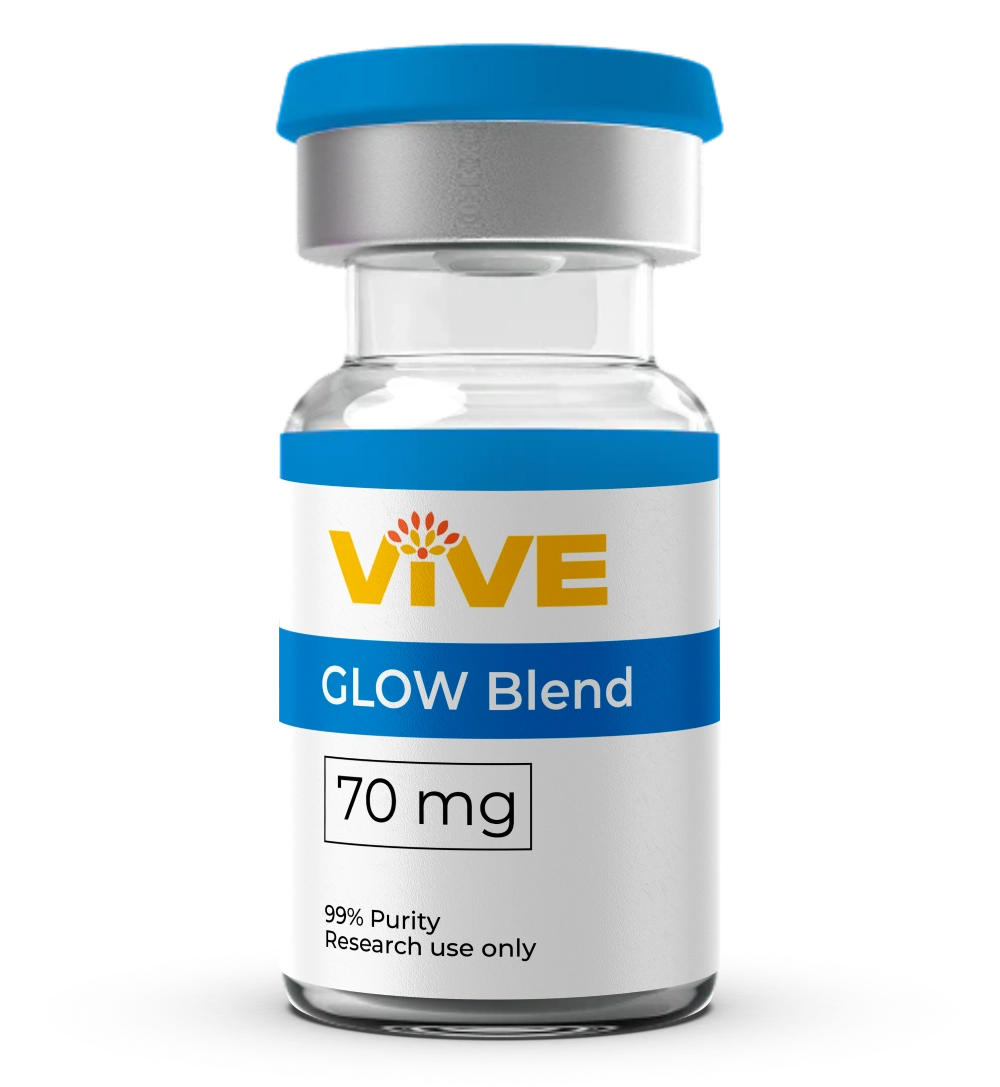
Glow Blend - BPC/TB/GHK
Research Use OnlyThese products are sold strictly for laboratory and research use only and are not approved for human consumption, diagnosis, or therapeutic treatment. Not for human or veterinary use. These statements have not been evaluated by the Food and Drug Administration, and nothing on this page constitutes medical advice or a health claim.
- Size
- 70mg
Specifications
Glow Blend - BPC/TB/GHK Technical Profile
OVERVIEW
What Is Glow Blend Peptide?
Glow Blend is a premium research-grade peptide blend developed by VivePeptides that combines three of the most extensively studied tissue and skin biology peptides: BPC-157, TB-500 (Thymosin Beta-4 fragment), and GHK-Cu copper peptide. This BPC-157 TB-500 GHK-Cu blend is formulated to provide researchers with a single integrated compound for studying multi-pathway tissue remodeling, extracellular matrix dynamics, and skin biology mechanisms.
Each component of the glow blend peptide brings a distinct research profile to the formulation. BPC-157 is studied for its interactions with growth factor pathways and nitric oxide signaling. TB-500 research focuses on actin sequestration and cell migration mechanisms. GHK-Cu is one of the most published copper peptides in skin research, with documented effects on collagen synthesis and gene expression modulation. Together, this skin rejuvenation peptide blend and tissue repair peptide blend offers a comprehensive research tool for laboratories investigating integrated tissue biology. When researchers buy glow blend from VivePeptides, they receive the best skin peptide blend available at ≥99% purity from a trusted USA supplier.
- 01
Multi-Peptide Tissue Research Blend
BPC-157 + TB-500 + GHK-Cu for integrated skin and tissue biology
- 02
≥99% HPLC Purity
Every component verified via high-performance liquid chromatography
- 03
USA Made & Verified
Third-party analytical testing performed in USA laboratories
RESEARCH
Glow Blend Mechanism of Action in Research
The glow blend mechanism of action leverages three complementary pathways, creating an integrated approach to tissue and skin biology research. Each component contributes distinct molecular mechanisms to the healing peptide blend research profile.
BPC-157: Growth Factor and NO System Modulation
Within the glow blend, BPC-157 contributes its well-characterized interactions with the nitric oxide system and growth factor pathways. Published research indicates BPC-157 may modulate VEGF-mediated angiogenesis, influence growth hormone receptor expression, and interact with the FAK-paxillin cell adhesion pathway. These mechanisms are complementary to the other blend components, providing growth factor-level tissue signaling.
TB-500: Actin Regulation and Cell Migration
TB-500 (Thymosin Beta-4 fragment) contributes actin-sequestering and cell migration mechanisms to the tissue repair peptide blend. Research demonstrates that TB-500 interacts with G-actin, promoting actin polymerization and influencing cell motility. Published studies indicate TB-500 may promote endothelial cell migration and differentiation, contributing to angiogenic processes studied in tissue biology research.
GHK-Cu: ECM Remodeling and Gene Expression
GHK-Cu provides the glow blend with its extensive extracellular matrix remodeling and gene expression modulation capabilities. Research documents GHK-Cu's influence on over 4,000 genes, its promotion of collagen and elastin synthesis, and its role as a bioavailable copper delivery system for enzymes like lysyl oxidase and superoxide dismutase. This broad gene-modulatory profile complements the more targeted mechanisms of BPC-157 and TB-500. ---
COMPARISON
Glow Blend vs Individual Repair Peptides: Research Comparison
Glow Blend
Comparing the Glow Blend to using individual repair peptides separately highlights the advantages of the integrated blend approach.
Individual Repair Peptides
The Glow Blend provides a streamlined approach for researchers studying integrated tissue and skin biology. Researchers requiring isolated single-pathway investigations may prefer individual peptides. VivePeptides offers both the glow blend peptide and each individual component at research-grade purity.
| Feature | Glow Blend | Individual Repair Peptides |
|---|---|---|
| Components | BPC-157 + TB-500 + GHK-Cu (integrated) | BPC-157, TB-500, or GHK-Cu separately |
| Pathways Covered | 3 complementary pathways simultaneously | 1 pathway per compound |
| Convenience | Single reconstitution | Multiple vials, separate reconstitutions |
| Multi-Pathway Synergy | Designed for integrated tissue research | Requires manual combination protocols |
| Consistency | Fixed optimized ratios per batch | Variable ratios across experiments |
| Purity | ≥99% per component | ≥99% per individual product |
| Cost Efficiency | Single blend purchase | Three separate product purchases |
| Best For | Integrated tissue/skin biology research | Isolated single-pathway mechanism studies |
RESEARCH STUDIES
Glow Blend Research Applications & Published Studies
While Glow Blend is a proprietary VivePeptides formulation, each component has extensive published research supporting its inclusion in this tissue and skin biology research blend.
BPC-157 Tissue Research Foundation
Published BPC-157 research provides a robust evidence base for its inclusion in the Glow Blend. Sikiric et al. (Journal of Physiology-Paris, 2003; Current Pharmaceutical Design, 2018) published comprehensive reviews of BPC-157's effects in tissue models spanning gastrointestinal, musculoskeletal, and vascular biology. These studies document BPC-157's broad tissue-supportive research profile that complements the other Glow Blend components.
TB-500 Cell Migration and Tissue Studies
Published TB-500 research by Goldstein et al. and subsequent investigators has characterized Thymosin Beta-4's role in actin biology, cell migration, and tissue remodeling. Studies using animal wound models have documented TB-500's effects on endothelial cell behavior and tissue repair processes, providing mechanistic support for its inclusion in the healing peptide blend.
GHK-Cu Skin Biology Research
The extensive GHK-Cu research literature, including genome-wide expression studies by Campbell et al. (Journal of Investigative Dermatology, 2012) and skin biology reviews by Pickart & Margolina (Biomedicines, 2018), establishes GHK-Cu as a premier skin research peptide. Its documented effects on collagen synthesis, ECM remodeling, and gene expression provide the skin-specific research dimension of the Glow Blend.
QUALITY ASSURANCE
Quality & Testing Standards
HPLC & Mass Spectrometry
Each Glow Blend component (BPC-157, TB-500, GHK-Cu) undergoes individual HPLC and mass spectrometry analysis.
Third-Party Verified
All components are independently verified through third-party USA-based analytical laboratories.
≥99% Purity Standard
Every component in the Glow Blend consistently meets or exceeds ≥99% purity for reliable research results.
FAQ
Frequently Asked Questions About Glow Blend
What is Glow Blend used for in research?
What purity is VivePeptides Glow Blend?
How should Glow Blend be stored?
What are the three components of Glow Blend?
Is VivePeptides Glow Blend third-party tested?
BPC-157
GHK-Cu
Individual BPC-157 for focused gastric peptide research
Individual GHK-Cu copper peptide for skin biology studies
SNAP-8
Acetyl Octapeptide-3 for anti-wrinkle research
NAD+
Explore More Research Peptides
Research grade compound for cellular aging studies
All Peptides → · Selank · Semax · MOTS-c · Tesamorelin · CJC-1295 No DAC + Ipamorelin · BAC Water
Add To Research Cart
Glow Blend - BPC/TB/GHK
99%+ purity · USA lab tested · secure shipping
You May Also Research
Related Compounds
These products are sold strictly for laboratory and research use only and are not approved for human consumption, diagnosis, or therapeutic treatment. Not for human or veterinary use. These statements have not been evaluated by the Food and Drug Administration, and nothing on this page constitutes medical advice or a health claim.