
Recovery & Repair
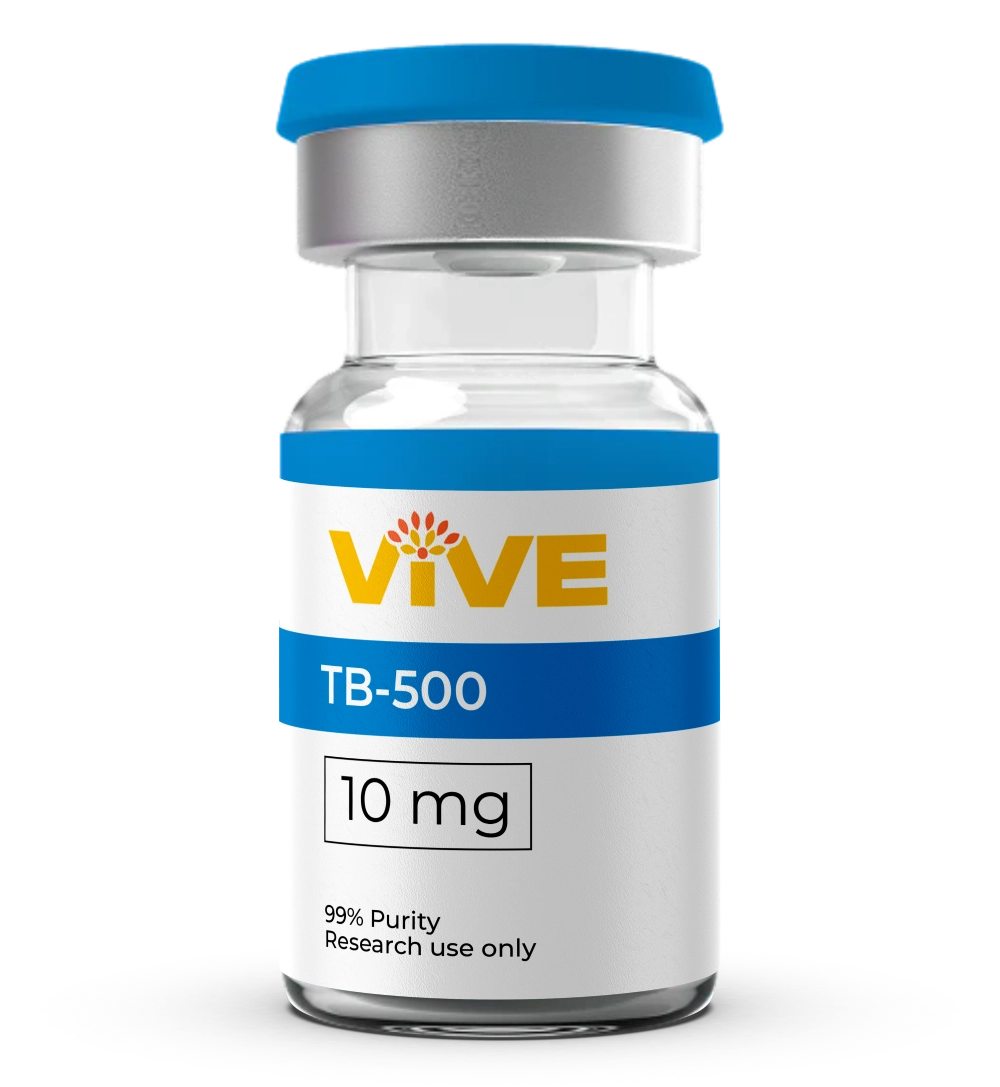
TB-500
Research Use OnlyThese products are sold strictly for laboratory and research use only and are not approved for human consumption, diagnosis, or therapeutic treatment. Not for human or veterinary use. These statements have not been evaluated by the Food and Drug Administration, and nothing on this page constitutes medical advice or a health claim.
- Size
- 10mg
Specifications
TB-500 Technical Profile
OVERVIEW
What Is TB-500 Peptide?
TB-500 is a synthetic peptide based on the active region of Thymosin Beta-4 (Tβ4), a highly conserved 43-amino-acid protein first isolated from the thymus gland. Tβ4 is one of the most abundant intracellular peptides in mammalian tissues and plays a central role in actin dynamics, cell motility, and tissue repair signaling. TB-500 encompasses the key functional domain responsible for actin sequestration and has been the subject of extensive preclinical research over the past two decades.
As a research peptide, TB-500 is primarily studied for its role in regulating the actin cytoskeleton and promoting cell migration. Research suggests that TB-500 interacts with G-actin monomers, preventing premature polymerization and maintaining a pool of monomeric actin available for directed cell movement. This mechanism, combined with TB-500's observed effects on angiogenesis and extracellular matrix remodeling in laboratory settings, has made it a foundational compound in tissue repair and regeneration research worldwide.
- 01
Actin-Binding Peptide
Synthetic fragment of Tβ4 containing the key LKKTETQ actin-sequestration domain
- 02
≥99% HPLC Purity
Every batch verified via high-performance liquid chromatography
- 03
USA Made & Verified
Third-party analytical testing performed in USA laboratories
RESEARCH
TB-500 Mechanism of Action in Research
The TB-500 mechanism of action centers on its interaction with the actin cytoskeleton and its downstream effects on cell migration, angiogenesis, and tissue remodeling. Published research has identified multiple pathways through which TB-500 influences cellular behavior in laboratory settings. TB-500 research continues to expand our understanding of how Thymosin Beta-4-derived peptides regulate tissue repair processes.
Actin Sequestration and Cytoskeletal Regulation
TB-500 binds to G-actin (globular actin) monomers through its LKKTETQ domain, preventing spontaneous F-actin (filamentous actin) polymerization. Research by Safer et al. (1997) demonstrated that Tβ4, and by extension its active fragment TB-500, functions as a major actin-sequestering protein, maintaining the dynamic equilibrium between G-actin and F-actin pools within cells. This regulation of actin dynamics is essential for directed cell migration, lamellipodia formation, and cellular remodeling processes studied in tissue repair research.
Cell Migration and Angiogenesis Promotion
Studies indicate that TB-500 promotes both cell migration and angiogenesis through complementary mechanisms. Malinda et al. (1999) published findings in the Journal of Investigative Dermatology demonstrating that Tβ4 promoted endothelial cell migration and tube formation, hallmarks of angiogenesis, in vitro. Additional research by Philp et al. (2004) showed that Tβ4-derived peptides increased matrix metalloproteinase (MMP) expression and enhanced extracellular matrix remodeling, providing mechanistic insight into how TB-500 facilitates tissue reorganization in research models.
Anti-Inflammatory and Survival Signaling
Beyond cytoskeletal effects, TB-500 research has revealed anti-inflammatory and cell survival properties. Sosne et al. (2007) published studies demonstrating that Tβ4 downregulated NF-κB-mediated inflammatory signaling and modulated cytokine expression in tissue injury models. Research also suggests that TB-500 may activate Akt-mediated survival pathways, contributing to reduced apoptosis in stressed cellular environments, adding another dimension to the peptide's tissue-protective research profile. ---
COMPARISON
TB-500 vs BPC-157: Research Peptide Comparison
TB-500
TB-500 and BPC-157 are two of the most frequently studied peptides in tissue repair and regeneration research. While they share overlapping research applications, they differ significantly in origin, structure, and proposed mechanisms of action. Understanding these differences helps researchers select the appropriate compound for their specific laboratory protocols.
BPC-157
Both peptides are valuable tools in tissue repair research, each acting through distinct molecular mechanisms. Some researchers have explored their combined use in preclinical models, though the majority of published literature examines each compound independently. VivePeptides offers both TB-500 for sale and BPC-157 at research grade purity from our USA-based facility.
| Feature | TB-500 (Thymosin Beta-4) | BPC-157 |
|---|---|---|
| Origin | Fragment of Thymosin Beta-4 (thymus gland) | Derived from human gastric juice protein |
| Amino Acids | 43 | 15 |
| CAS Number | 77591-33-4 | 137525-51-0 |
| Molecular Weight | 4963.50 Da | 1419.53 Da |
| Primary Research Focus | Cell migration and tissue repair | Gastric and tissue research |
| Key Mechanism | Actin sequestration, cell motility | NO system, growth factor modulation |
| Angiogenesis | Promotes via endothelial cell migration | Promotes via VEGF pathways |
| Anti-Inflammatory | NF-κB modulation | Cytokine modulation |
| Research Volume | 50+ published studies | 100+ published studies |
RESEARCH STUDIES
TB-500 Research Applications & Published Studies
TB-500 research spans two decades of published preclinical literature focused on tissue repair, cell migration, and regenerative biology. The following areas represent the most actively investigated applications of TB-500 peptide. All references are to research contexts only.
Wound Healing and Tissue Repair Research
The primary body of TB-500 research concerns tissue repair mechanisms. Malinda et al. (1999) published foundational work in the Journal of Investigative Dermatology demonstrating that Thymosin Beta-4 accelerated dermal wound closure in animal models. Philp et al. (2004) expanded this research in the FASEB Journal, showing that Tβ4 promoted full-thickness dermal wound repair through enhanced cell migration, angiogenesis, and collagen deposition. These studies established TB-500 as a key research compound in wound biology.
Cardiac Tissue Research
Research has explored TB-500 in cardiac tissue models with significant findings. Bock-Marquette et al. (2004) published a landmark study in Nature demonstrating that Tβ4 promoted survival of cardiac myocytes and enhanced cardiac function in murine models following injury. Smart et al. (2007) further demonstrated that Tβ4 could reactivate epicardial progenitor cells, opening new avenues of investigation in cardiac regeneration research.
Corneal and Ocular Research
TB-500 research has yielded notable results in ocular tissue models. Sosne et al. (2002) published studies demonstrating that Tβ4 promoted corneal wound healing and reduced inflammatory markers in ocular surface injury models. Subsequent research by the same group (Sosne et al., 2007) investigated Tβ4's anti-inflammatory mechanisms in corneal epithelial cells, documenting NF-κB pathway modulation and cytokine regulation.
QUALITY ASSURANCE
Quality & Testing Standards
VivePeptides maintains rigorous quality control for every batch of TB-500 peptide. Our commitment to research-grade purity ensures that laboratories receive consistent, reliable compounds for their investigations.
HPLC & Mass Spectrometry
Every batch of TB-500 undergoes high-performance liquid chromatography (HPLC) and mass spectrometry analysis to confirm identity, purity, and molecular weight.
Third-Party Verified
All VivePeptides TB-500 is independently verified through third-party analytical laboratories based in the USA. Testing documentation is available for every lot.
≥99% Purity Standard
Our TB-500 consistently meets or exceeds ≥99% purity as determined by HPLC analysis, ensuring research-grade quality for laboratory applications.
FAQ
Frequently Asked Questions About TB-500
What is TB-500 used for in research?
What purity is VivePeptides TB-500?
How should TB-500 be stored?
What is the difference between TB-500 and Thymosin Beta-4?
Is VivePeptides TB-500 third-party tested?
BPC-157
Glow Blend (BPC-157 + TB-500 + GHK-Cu)
Research grade gastric pentadecapeptide for tissue biology studies
Multi-pathway tissue repair research blend
GHK-Cu Copper Peptide
Research grade copper peptide for skin and tissue biology studies
MOTS-c
Mitochondrial-derived peptide for metabolic research
Explore More Research Peptides
All Peptides → · BPC-157 · GHK-Cu · Selank · IGF-1 LR3 · Tesamorelin · BAC Water
Add To Research Cart
TB-500
99%+ purity · USA lab tested · secure shipping
These products are sold strictly for laboratory and research use only and are not approved for human consumption, diagnosis, or therapeutic treatment. Not for human or veterinary use. These statements have not been evaluated by the Food and Drug Administration, and nothing on this page constitutes medical advice or a health claim.