
Recovery & Repair
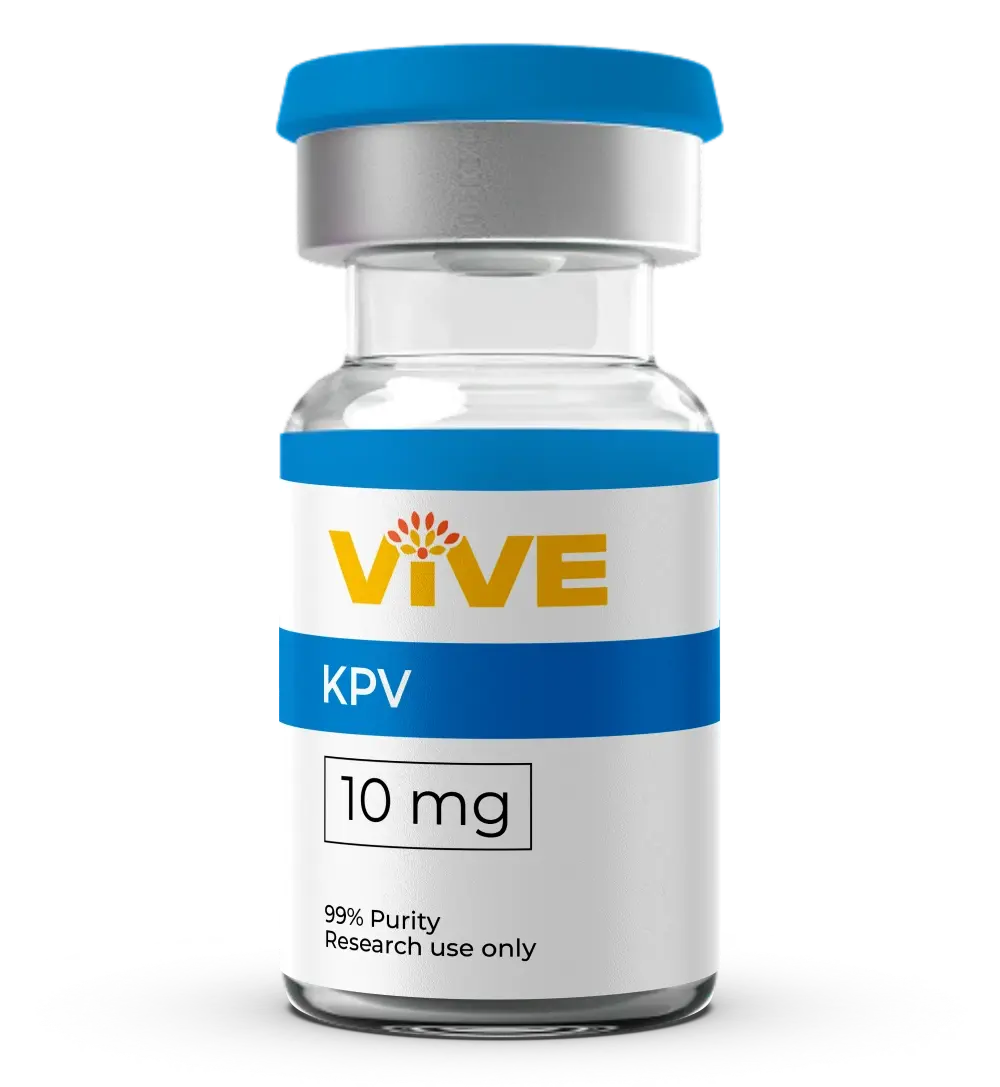
KPV
Research Use OnlyThese products are sold strictly for laboratory and research use only and are not approved for human consumption, diagnosis, or therapeutic treatment. Not for human or veterinary use. These statements have not been evaluated by the Food and Drug Administration, and nothing on this page constitutes medical advice or a health claim.
- Size
- 10mg
Specifications
KPV Technical Profile
OVERVIEW
What Is KPV (Lys-Pro-Val)?
KPV is a tripeptide composed of lysine, proline, and valine (Lys-Pro-Val), corresponding to residues 11 to 13 at the C-terminus of alpha-melanocyte-stimulating hormone (alpha-MSH). Alpha-MSH is a 13-residue neuropeptide with well-documented anti-inflammatory activity, and a long line of structure-activity work established that much of that activity is carried by its final three residues. KPV is that minimal fragment, supplied as the free tripeptide (CAS 67727-97-3, C16H30N4O4, 342.44 g/mol).
What makes KPV interesting as a research reagent is what it does not do. The melanocortin receptor pharmacophore of alpha-MSH sits in the His-Phe-Arg-Trp core, not the C-terminal tail, so KPV retains anti-inflammatory signaling activity without acting as a melanocortin receptor agonist. That separation lets researchers study the anti-inflammatory arm of melanocortin biology independently of pigmentation, steroidogenic, and other receptor-driven effects. KPV research concentrates on NF-kB pathway inhibition, intestinal and epithelial inflammation models, wound-healing models, and antimicrobial activity. Researchers who buy KPV from VivePeptides receive a lyophilized preparation at greater than or equal to 99% purity from a trusted USA supplier.
- 01
C-Terminal Alpha-MSH Fragment
Lys-Pro-Val, residues 11 to 13 of alpha-melanocyte-stimulating hormone
- 02
≥99% HPLC Purity
Every batch verified via high-performance liquid chromatography
- 03
USA Made & Verified
Third-party analytical testing performed in USA laboratories
RESEARCH
KPV Mechanism of Action in Research
The KPV mechanism of action described in the literature is intracellular rather than receptor-mediated. Rather than binding a surface receptor, KPV is taken up into cells by a peptide transporter and then acts on inflammatory signaling from the inside, an unusual profile that accounts for much of the experimental interest in this tripeptide (Dalmasso et al., Gastroenterology, 2008).
PepT1-Mediated Cellular Uptake
KPV enters intestinal epithelial and immune cells through PepT1 (SLC15A1), the di- and tripeptide transporter. Dalmasso and colleagues showed that uptake is PepT1-dependent and that the anti-inflammatory effect tracks with transporter expression (Gastroenterology, 2008). Because PepT1 is upregulated in inflamed intestinal epithelium, the transporter itself has become a focus of targeted-delivery research (Viennois et al., Cellular and Molecular Gastroenterology and Hepatology, 2016).
NF-kB and MAPK Pathway Inhibition
Once internalized, KPV inhibits nuclear translocation of NF-kB and dampens MAP-kinase signaling, reducing transcription of pro-inflammatory cytokines such as IL-6, IL-8, and TNF-alpha in epithelial and immune cell models. This is the same downstream signaling axis through which the parent hormone alpha-MSH exerts its anti-inflammatory effects (Brzoska et al., Endocrine Reviews, 2008).
Melanocortin-Receptor-Independent Activity
The receptor-binding pharmacophore of alpha-MSH resides in its core His-Phe-Arg-Trp sequence, which KPV does not contain. KPV therefore reproduces anti-inflammatory signaling without functioning as an MC1R through MC5R agonist, giving researchers a way to isolate the anti-inflammatory component of melanocortin biology from pigmentation and other receptor-mediated outcomes. ---
COMPARISON
KPV vs BPC-157: Research Compound Comparison
KPV
KPV and BPC-157 are frequently compared because both appear in gastrointestinal and tissue-repair research, but they are structurally unrelated and act through different proposed pathways. Understanding the distinction matters when selecting a compound for an inflammation versus a repair endpoint.
BPC-157
KPV is a three-residue alpha-MSH fragment studied primarily as an anti-inflammatory signaling inhibitor. BPC-157 is a fifteen-residue sequence derived from a human gastric juice protein, studied primarily in angiogenesis and tissue-repair models. VivePeptides KPV for sale is manufactured to greater than or equal to 99% purity for reliable laboratory research.
| Feature | KPV | BPC-157 |
|---|---|---|
| CAS Number | 67727-97-3 | 137525-51-0 |
| Molecular Weight | 342.44 g/mol | 1419.5 g/mol |
| Structure | Tripeptide (Lys-Pro-Val) | Pentadecapeptide, 15 residues (GEPPPGKPADDAGLV) |
| Origin | C-terminal fragment (11-13) of alpha-MSH | Partial sequence of human gastric juice protein BPC |
| Proposed Mechanism | PepT1-mediated uptake, then NF-kB and MAPK inhibition | Angiogenic signaling via VEGFR2 and nitric oxide pathway modulation |
| Primary Research Focus | Inflammation: colitis, epithelial and skin inflammation models | Repair: tendon, ligament, muscle, and gastrointestinal tissue models |
| Receptor Activity | None at melanocortin receptors | No single identified receptor target |
RESEARCH STUDIES
KPV Research Applications & Published Studies
KPV has a focused but well-cited preclinical literature centered on intestinal inflammation, dermatological inflammation, and antimicrobial activity. All published work to date is in cell and animal models.
Intestinal Inflammation & Colitis Models
The defining study in this area is Dalmasso and colleagues, PepT1-mediated tripeptide KPV uptake reduces intestinal inflammation (Gastroenterology, 2008), which demonstrated transporter-dependent uptake and reduced inflammatory signaling in murine colitis models. Viennois and colleagues later examined PepT1 in colitis-associated cancer and the effect of KPV in the same system (Cellular and Molecular Gastroenterology and Hepatology, 2016). More recent reviews place KPV within melanocortin-system research in inflammatory bowel disease (Cells, 2023).
Skin, Epithelial & Wound-Healing Models
Structure-activity studies established that the anti-inflammatory message of alpha-MSH resides in the C-terminal tripeptide, which is why KPV appears in dermatological and epithelial research and in cosmetic-science literature. Recent work examines KPV in keratinocyte models, including protection against particulate-matter-induced apoptosis (Tissue and Cell, 2025), alongside hydrogel and topical delivery formulations.
Antimicrobial Activity
Alpha-MSH and its C-terminal KPV fragment have been reported to inhibit growth of the gram-positive bacterium Staphylococcus aureus and the yeast Candida albicans in vitro, an activity distinct from the peptide's anti-inflammatory signaling. This makes KPV a reagent of interest in host-defense-peptide research. KPV has no approved human medical use in any jurisdiction and is sold here strictly as a research chemical.
QUALITY ASSURANCE
Quality & Testing Standards
HPLC & Mass Spectrometry
Every KPV batch undergoes HPLC and mass spectrometry analysis to confirm identity, purity, and molecular weight.
Third-Party Verified
All KPV is independently tested at third-party USA-based analytical laboratories with lot-specific documentation.
≥99% Purity Standard
VivePeptides KPV consistently meets or exceeds ≥99% purity as verified by HPLC for reliable research results.
FAQ
Frequently Asked Questions About KPV
What is KPV used for in research?
What is the relationship between KPV and alpha-MSH?
What purity is VivePeptides KPV?
How should KPV be stored?
How is KPV different from BPC-157?
Why is KPV described as orally active in the literature?
Is VivePeptides KPV third-party tested?
Add To Research Cart
KPV
99%+ purity · USA lab tested · secure shipping
These products are sold strictly for laboratory and research use only and are not approved for human consumption, diagnosis, or therapeutic treatment. Not for human or veterinary use. These statements have not been evaluated by the Food and Drug Administration, and nothing on this page constitutes medical advice or a health claim.