
Specialty
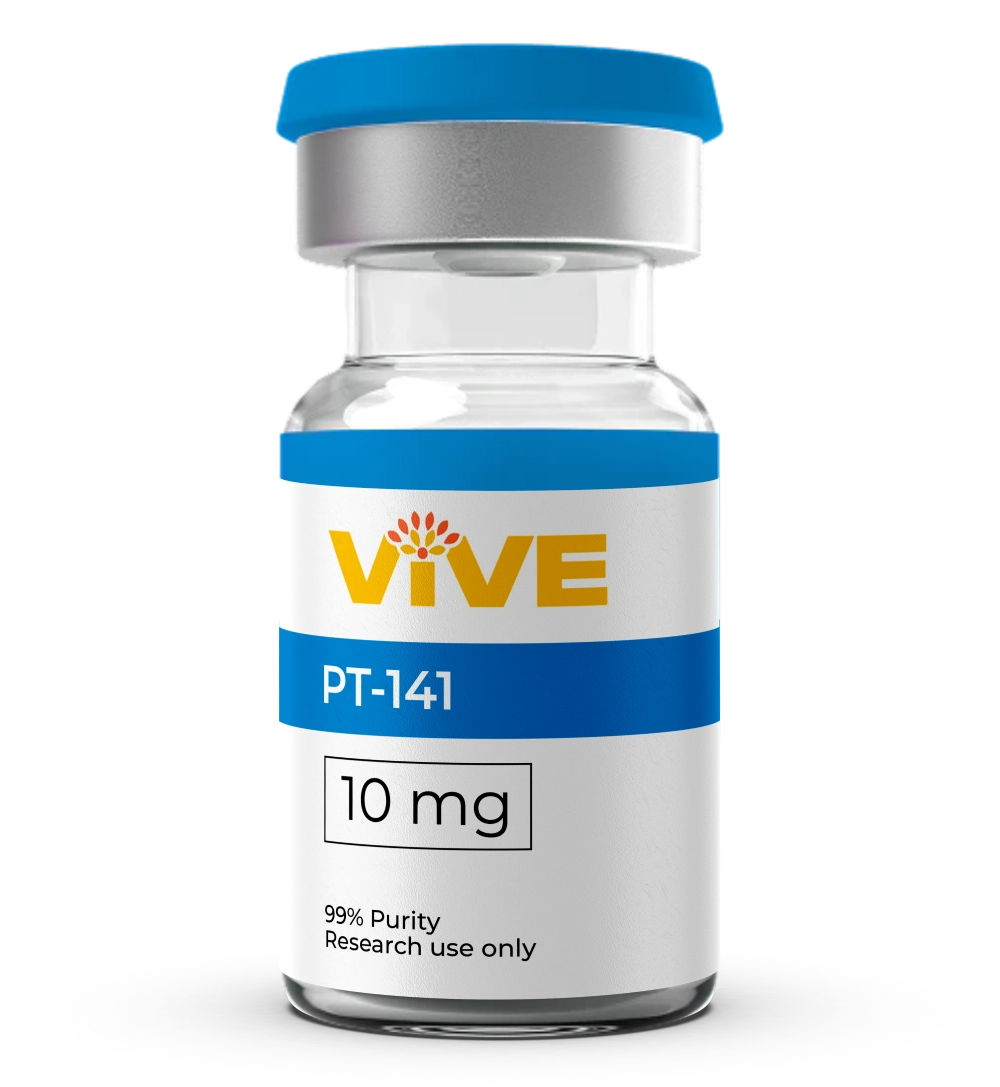
PT-141
Research Use OnlyThese products are sold strictly for laboratory and research use only and are not approved for human consumption, diagnosis, or therapeutic treatment. Not for human or veterinary use. These statements have not been evaluated by the Food and Drug Administration, and nothing on this page constitutes medical advice or a health claim.
- Size
- 10mg
Specifications
PT-141 Technical Profile
OVERVIEW
What Is PT 141 Peptide?
PT 141 is a synthetic cyclic heptapeptide and melanocortin receptor agonist, also known by its pharmaceutical name Bremelanotide. Originally derived from the melanotropin peptide Melanotan II (MT-II), PT 141 was developed during research into melanocortin receptor signaling and was subsequently found to activate central nervous system pathways associated with sexual function. In 2019, the FDA approved Bremelanotide for a specific indication, making it one of the few melanocortin receptor agonists to achieve regulatory approval for clinical use.
As a research peptide, PT 141 belongs to the class of melanocortin receptor ligands that interact with the MC3R and MC4R receptor subtypes. Unlike compounds that act on peripheral vascular mechanisms, PT 141 research has demonstrated a centrally acting mechanism through hypothalamic and limbic neural pathways. This neurogenic mechanism of action has made PT 141 a valuable tool in neuroscience research, melanocortin receptor pharmacology, and neuroendocrine signaling studies.
- 01
Melanocortin Receptor Agonist
Synthetic cyclic heptapeptide targeting MC3R and MC4R receptor subtypes in the central nervous system
- 02
≥99% HPLC Purity
Every batch verified via high-performance liquid chromatography
- 03
USA Made & Verified
Third-party analytical testing performed in USA laboratories
RESEARCH
PT 141 Mechanism of Action in Research
The PT 141 mechanism of action is distinguished by its central nervous system activity, operating through melanocortin receptor pathways in the brain rather than peripheral vascular mechanisms. Research over the past two decades has elucidated the specific receptor interactions and downstream signaling cascades that mediate its observed effects.
MC3R and MC4R Receptor Activation
PT 141 functions as a selective agonist for melanocortin-3 (MC3R) and melanocortin-4 (MC4R) receptors, with preferential activity at MC4R. These receptors are G-protein coupled receptors expressed primarily in the hypothalamus and limbic regions of the brain. Research by Hadley and Dorr (2006) demonstrated that PT 141 binding to MC4R activates Gs-protein signaling, increasing intracellular cAMP and triggering downstream neural cascades. The MC4R receptor has been identified as a key mediator of PT 141's observed central effects in preclinical models.
Neurotransmitter System Modulation
Research indicates that MC4R activation by PT 141 modulates multiple neurotransmitter systems. Published studies have demonstrated downstream effects on dopaminergic signaling in mesolimbic pathways, norepinephrine release, and oxytocin secretion. Diamond et al. (2006) published findings showing that PT 141 administration in animal models produced measurable changes in hypothalamic neurotransmitter activity, establishing a direct link between melanocortin receptor activation and neurogenic signaling cascades.
Cyclic Peptide Structure and Receptor Selectivity
PT 141's cyclic lactam bridge structure, formed between the Asp and Lys residues, contributes to its receptor selectivity and metabolic stability. Research into the structure-activity relationships of melanocortin peptides has demonstrated that this cyclization enhances binding affinity for MC3R and MC4R while reducing activity at other melanocortin receptor subtypes. The incorporation of D-Phe (D-phenylalanine) further enhances receptor binding and resistance to enzymatic degradation compared to linear melanocortin peptides.
COMPARISON
PT 141 vs Melanotan II: Research Peptide Comparison
PT 141
Both PT 141 and Melanotan II (MT-II) are synthetic melanocortin receptor agonists derived from the same parent peptide, alpha-MSH. While they share structural similarities and melanocortin receptor affinity, they differ in their receptor selectivity profiles and primary research applications. Understanding these differences helps researchers select the appropriate compound for their specific laboratory protocols.
Melanotan II
Both peptides are used in melanocortin receptor pharmacology research. PT 141 is preferred for studies investigating central nervous system melanocortin signaling due to its MC4R selectivity. Melanotan II is used more broadly in melanocortin receptor mapping and melanogenesis research due to its non-selective receptor profile. VivePeptides offers both PT 141 and Melanotan II at research-grade purity from our USA-based facility.
| Feature | PT 141 | Melanotan II |
|---|---|---|
| Origin | Derived from Melanotan II | Synthetic analog of alpha-MSH |
| Amino Acids | 7 (cyclic) | 7 (cyclic) |
| CAS Number | 189691-06-3 | 121062-08-6 |
| Molecular Weight | 1025.2 Da | 1024.2 Da |
| Primary Research Focus | MC3R/MC4R central nervous system signaling | Broad melanocortin receptor activation |
| Receptor Selectivity | Preferential MC4R agonism | Non-selective MC1R through MC5R |
| Key Structural Difference | Acetylated N-terminus, no melanotropic ring | Full melanotropic core with Nle substitution |
| Research Volume | 100+ published studies | 80+ published studies |
RESEARCH STUDIES
PT 141 Research Applications & Published Studies
PT 141 research spans over two decades of published preclinical and clinical literature. The following areas represent the most actively investigated applications. All references are to research contexts only.
Melanocortin Receptor Pharmacology
PT 141 has served as a primary tool for mapping melanocortin receptor function in the central nervous system. Hadley and Dorr (2006) published comprehensive reviews of melanocortin receptor pharmacology using PT 141 as a selective probe. Research by Wikberg et al. (2000) used melanocortin ligands including PT 141 precursors to map receptor distribution and signaling in hypothalamic and limbic brain regions, contributing to the understanding of melanocortin receptor biology.
Neuroendocrine Signaling Research
Published studies have examined PT 141's effects on neuroendocrine pathways. Diamond et al. (2006) reported observations of PT 141-mediated changes in hypothalamic neurotransmitter levels in preclinical models. Subsequent research explored downstream effects on oxytocin release, dopaminergic activity, and hypothalamic-pituitary axis function, establishing PT 141 as a valuable pharmacological tool for investigating brain-mediated neuroendocrine signaling.
Central Nervous System Receptor Mapping
PT 141 research has contributed to the broader understanding of G-protein coupled receptor signaling in the CNS. Studies investigating PT 141's interaction with MC3R and MC4R have provided insights into receptor desensitization, internalization, and downstream cAMP/PKA signaling that are applicable beyond melanocortin-specific research. These pharmacological studies have been published in journals including the Journal of Pharmacology and Experimental Therapeutics and Peptides.
QUALITY ASSURANCE
Quality & Testing Standards
VivePeptides maintains rigorous quality control for every batch of PT 141 peptide. Our commitment to research-grade purity ensures that laboratories receive consistent, reliable compounds for their investigations.
HPLC & Mass Spectrometry
Every batch of PT 141 undergoes high-performance liquid chromatography (HPLC) and mass spectrometry analysis to confirm identity, purity, and molecular weight.
Third-Party Verified
All VivePeptides PT 141 is independently verified through third-party analytical laboratories based in the USA. Testing documentation is available for every lot.
≥99% Purity Standard
Our PT 141 consistently meets or exceeds ≥99% purity as determined by HPLC analysis, ensuring research-grade quality for laboratory applications.
FAQ
Frequently Asked Questions About PT 141
What is PT 141 used for in research?
What purity is VivePeptides PT 141?
How should PT 141 be stored?
What is the difference between PT 141 and Melanotan II?
Is VivePeptides PT 141 third-party tested?
BPC-157
CJC-1295 + Ipamorelin
Gastric pentadecapeptide for multi-pathway protective research
Growth hormone secretagogue research blend for neuroendocrine studies
Sermorelin
GHRH analog for pituitary function and GH release research
Explore More Research Peptides
Selank · Semax · Tesamorelin · NAD+ · SNAP-8 · All Peptides →
Add To Research Cart
PT-141
99%+ purity · USA lab tested · secure shipping
These products are sold strictly for laboratory and research use only and are not approved for human consumption, diagnosis, or therapeutic treatment. Not for human or veterinary use. These statements have not been evaluated by the Food and Drug Administration, and nothing on this page constitutes medical advice or a health claim.