
Longevity & Cellular
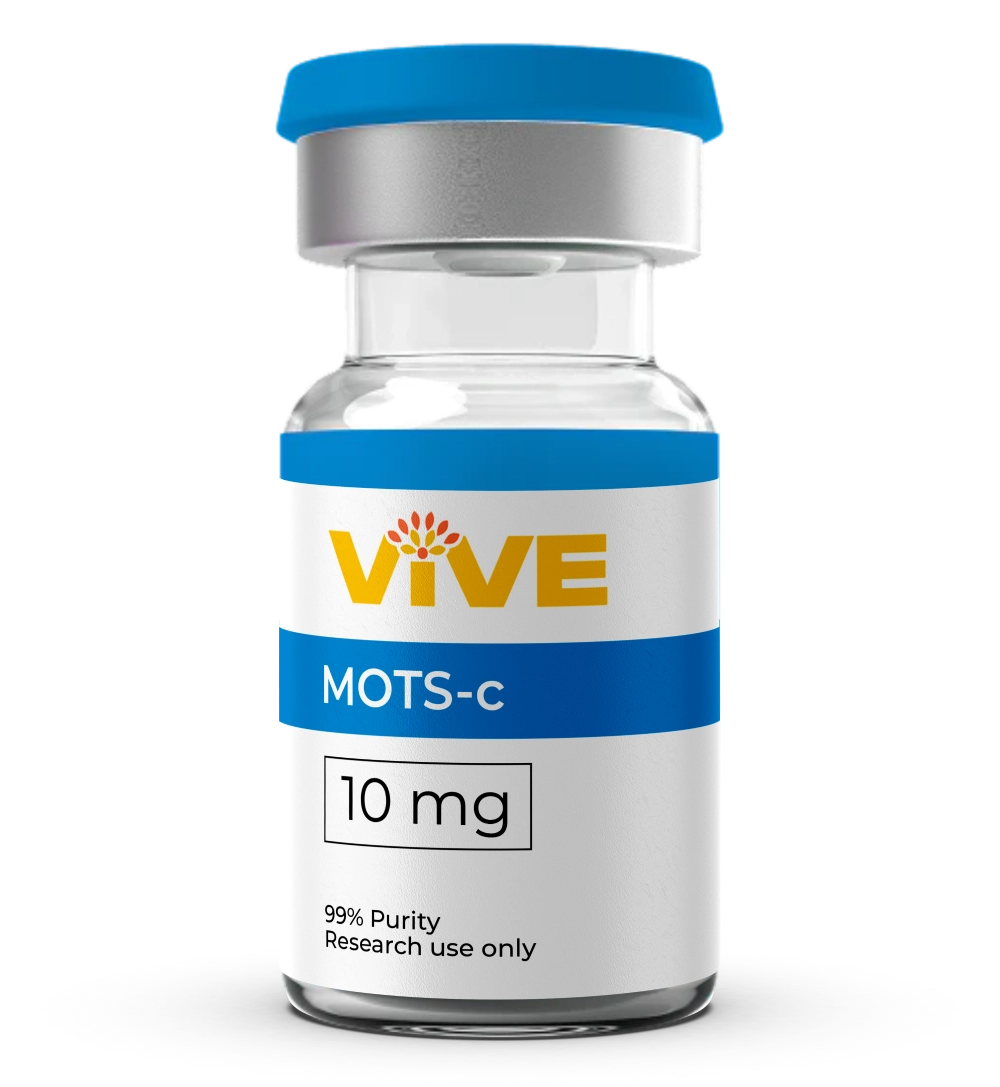
MOTS-c
Research Use OnlyThese products are sold strictly for laboratory and research use only and are not approved for human consumption, diagnosis, or therapeutic treatment. Not for human or veterinary use. These statements have not been evaluated by the Food and Drug Administration, and nothing on this page constitutes medical advice or a health claim.
- Size
- Default Title
Specifications
MOTS-c Technical Profile
OVERVIEW
What Is MOTS-c Peptide?
MOTS-c (Mitochondrial Open Reading Frame of the 12S rRNA Type-c) is a 16-amino acid peptide encoded within the mitochondrial genome, specifically within the 12S ribosomal RNA gene. Discovered by Dr. Changhan David Lee and colleagues at the University of Southern California in 2015, MOTS-c represents a groundbreaking class of signaling molecules known as mitochondrial-derived peptides (MDPs). The discovery that mitochondrial DNA encodes functional peptides beyond the 13 known mitochondrial proteins fundamentally altered our understanding of mitochondrial biology.
As a MOTS-c mitochondrial peptide, this compound is unique in that it originates from the organellar genome rather than nuclear DNA. MOTS-c research has focused on its role as a retrograde signaling molecule, a messenger that communicates mitochondrial status to the nuclear genome and influences systemic metabolic regulation. MOTS-c metabolism research and MOTS-c exercise research have been particularly active areas of investigation, with studies exploring how this peptide integrates mitochondrial energy sensing with cellular metabolic programming in laboratory models.
- 01
Mitochondrial-Derived Peptide
16-amino acid peptide encoded in mitochondrial 12S rRNA gene
- 02
≥99% HPLC Purity
Every batch verified via high-performance liquid chromatography
- 03
USA Made & Verified
Third-party analytical testing performed in USA laboratories
RESEARCH
MOTS-c Mechanism of Action in Research
The MOTS-c mechanism of action involves a novel form of mitochondria-to-nucleus communication called retrograde signaling. MOTS-c research has identified several key pathways through which this mitochondrial-derived peptide influences cellular metabolism.
AMPK Pathway Activation
MOTS-c research has demonstrated that the peptide activates AMP-activated protein kinase (AMPK), a master regulator of cellular energy homeostasis. Studies indicate that MOTS-c may influence AMPK signaling by modulating the folate-methionine cycle and de novo purine biosynthesis, leading to accumulation of the AMPK activator AICAR (5-aminoimidazole-4-carboxamide ribonucleotide). This metabolic pathway represents a unique mechanism distinct from conventional AMPK activators (Lee et al., Cell Metabolism, 2015).
Nuclear Translocation and Gene Regulation
A remarkable finding in MOTS-c research is that this mitochondrially-encoded peptide can translocate to the nucleus under conditions of metabolic stress. Published studies demonstrate that MOTS-c accumulates in the nucleus and interacts with antioxidant response element (ARE) sequences in promoter regions of stress-responsive genes. This direct mitochondria-to-nucleus signaling pathway represents a novel form of retrograde communication (Kim et al., Cell Metabolism, 2018).
Metabolic Reprogramming
MOTS-c metabolism research has revealed effects on cellular metabolic programming, including modulation of glucose uptake, fatty acid oxidation, and one-carbon metabolism. Studies indicate MOTS-c may influence metabolic flexibility, the ability of cells to switch between fuel sources, in various tissue types studied in laboratory settings. ---
COMPARISON
MOTS-c vs SS-31: Mitochondrial Peptide Research Comparison
MOTS-c
MOTS-c and SS-31 (Elamipretide) are both studied in mitochondrial research but differ fundamentally in origin, structure, and proposed mechanisms.
SS-31
MOTS-c and SS-31 target different aspects of mitochondrial biology, making them complementary research tools. VivePeptides MOTS-c for sale at ≥99% purity provides researchers with a reliable compound for metabolic and mitochondrial signaling studies.
| Feature | MOTS-c | SS-31 (Elamipretide) |
|---|---|---|
| Origin | Endogenous, mitochondrial DNA-encoded | Synthetic, designed peptide |
| CAS Number | 1627580-64-6 | 736992-21-5 |
| Amino Acids | 16 | 4 (D-Arg-Dmt-Lys-Phe-NH₂) |
| Molecular Weight | 2174.67 Da | 640.75 Da |
| Mitochondrial Target | Retrograde signaling (mito-to-nucleus) | Cardiolipin / inner membrane |
| Primary Mechanism | AMPK activation, gene regulation | Electron transport chain optimization |
| Research Focus | Metabolic sensing, exercise biology | Mitochondrial bioenergetics, oxidative stress |
| Genome of Origin | Mitochondrial | N/A (synthetic) |
RESEARCH STUDIES
MOTS-c Research Applications & Published Studies
MOTS-c research is a rapidly expanding field since the peptide's discovery in 2015, with published studies in leading journals including Cell Metabolism and Nature Communications.
Metabolic Signaling Discovery
The foundational MOTS-c research by Lee et al. (Cell Metabolism, 2015) characterized MOTS-c as a novel mitochondrial-derived peptide that regulates metabolic homeostasis. This landmark study demonstrated MOTS-c's effects on folate-methionine metabolism, AMPK activation, and glucose utilization in cell culture and animal models, establishing the field of MOTS-c metabolism research.
Exercise Biology Research
MOTS-c exercise research has generated significant interest. Reynolds et al. (Nature Communications, 2021) published findings showing that MOTS-c levels in circulation are influenced by physical activity. Studies in aged mouse models demonstrated that MOTS-c administration improved physical capacity parameters, suggesting a role for this peptide in exercise-responsive metabolic signaling pathways.
Aging and Cellular Senescence Studies
Published MOTS-c research has explored the peptide's relationship to aging biology. Studies have documented that endogenous MOTS-c levels may decline with age across multiple species, while exogenous MOTS-c administration in aged animal models has been associated with improvements in metabolic parameters. These findings have positioned MOTS-c as a key research compound in geroscience.
QUALITY ASSURANCE
Quality & Testing Standards
HPLC & Mass Spectrometry
Every MOTS-c batch undergoes HPLC and mass spectrometry to verify peptide identity, correct sequence, and purity.
Third-Party Verified
All MOTS-c is independently tested at third-party USA-based analytical laboratories with documentation for every lot.
≥99% Purity Standard
VivePeptides MOTS-c consistently meets or exceeds ≥99% purity for dependable research outcomes.
FAQ
Frequently Asked Questions About MOTS-c
What is MOTS-c used for in research?
What purity is VivePeptides MOTS-c?
How should MOTS-c be stored?
What makes MOTS-c unique among peptides?
Is VivePeptides MOTS-c third-party tested?
NAD+
Tesamorelin
Research grade compound for cellular energy and aging studies
GHRH analog for growth hormone research
BPC-157
Explore More Research Peptides
Gastric pentadecapeptide for tissue research
Explore More Research Peptides
All Peptides → · Vive GLP(R) · GHK-Cu · Selank · Semax · CJC-1295 No DAC + Ipamorelin · BAC Water
Add To Research Cart
MOTS-c
99%+ purity · USA lab tested · secure shipping
You May Also Research
Related Compounds
These products are sold strictly for laboratory and research use only and are not approved for human consumption, diagnosis, or therapeutic treatment. Not for human or veterinary use. These statements have not been evaluated by the Food and Drug Administration, and nothing on this page constitutes medical advice or a health claim.