
Growth & Repair
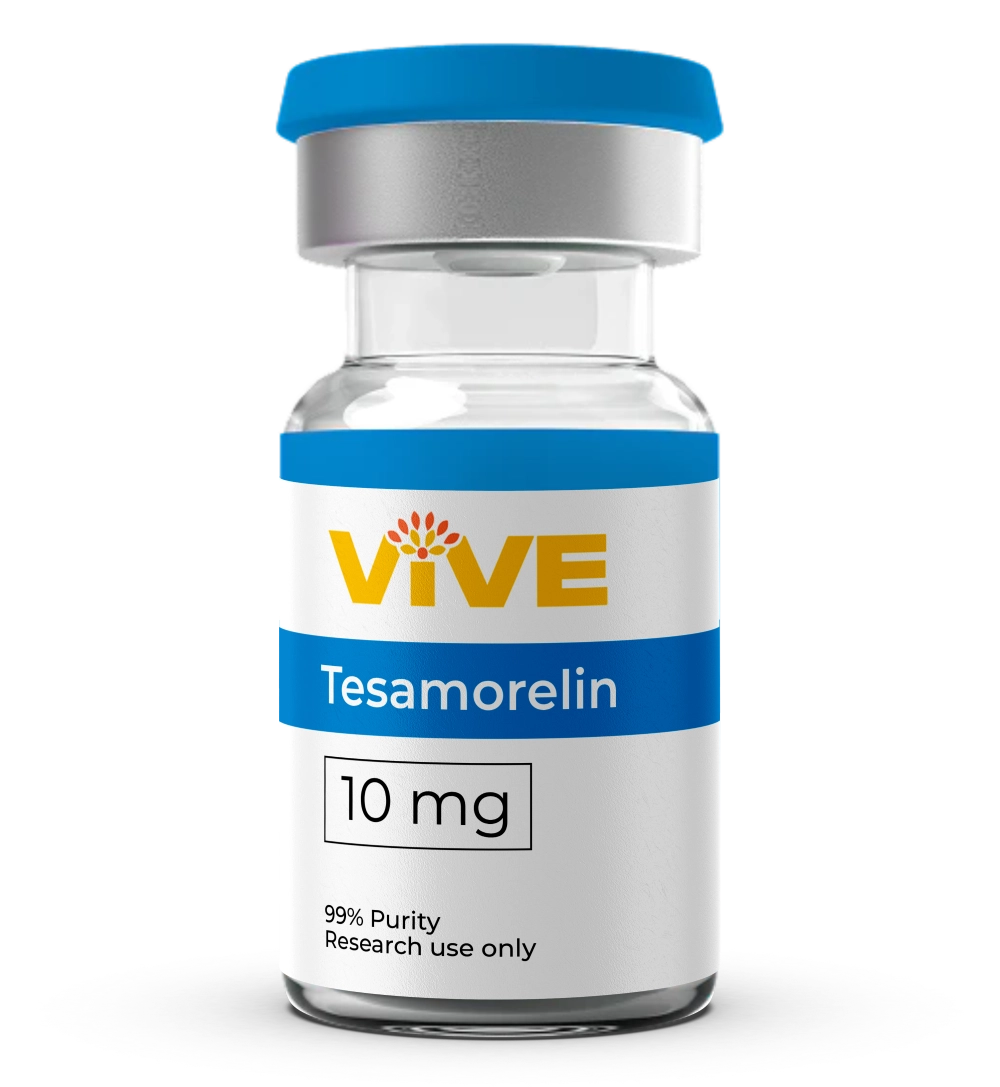
Tesamorelin
Research Use OnlyThese products are sold strictly for laboratory and research use only and are not approved for human consumption, diagnosis, or therapeutic treatment. Not for human or veterinary use. These statements have not been evaluated by the Food and Drug Administration, and nothing on this page constitutes medical advice or a health claim.
Formula
- Size
- 5mg
Specifications
Tesamorelin Technical Profile
OVERVIEW
What Is Tesamorelin Peptide?
Tesamorelin is a synthetic analog of human growth hormone-releasing hormone (GHRH), consisting of the full 44-amino acid GHRH sequence modified with a trans-3-hexenoic acid group attached to the tyrosine residue at position 1. This modification enhances the peptide's stability while preserving its ability to interact with GHRH receptors. As a tesamorelin GHRH analog, it represents one of the most well-characterized compounds in growth hormone axis research.
Tesamorelin peptide was originally developed by Theratechnologies and has been the subject of extensive preclinical and research investigation. Tesamorelin growth hormone research has documented its ability to stimulate pituitary somatotroph cells through GHRH receptor activation, leading to pulsatile growth hormone secretion in research models. The peptide's defined mechanism and well-characterized pharmacology make it a valuable research tool for studying the somatotropic axis, GH-IGF-1 signaling, and related metabolic pathways in laboratory settings.
- 01
GHRH Analog
Modified 44-amino acid growth hormone-releasing hormone peptide
- 02
≥99% HPLC Purity
Every batch verified via high-performance liquid chromatography
- 03
USA Made & Verified
Third-party analytical testing performed in USA laboratories
RESEARCH
Tesamorelin Mechanism of Action in Research
The tesamorelin mechanism of action follows the classical GHRH signaling pathway while offering enhanced stability over native GHRH. Tesamorelin research has characterized its receptor pharmacology and downstream effects on the somatotropic axis.
GHRH Receptor Activation
Tesamorelin binds to the GHRH receptor (GHRH-R), a G-protein coupled receptor expressed on anterior pituitary somatotroph cells. Upon receptor binding, tesamorelin activates the Gs-adenylyl cyclase-cAMP-PKA signaling cascade, leading to calcium influx and growth hormone (GH) release from secretory granules. Published tesamorelin research demonstrates that the trans-3-hexenoic acid modification does not significantly alter receptor binding affinity compared to native GHRH, while providing improved metabolic stability.
Pulsatile Growth Hormone Secretion
A key feature of the tesamorelin mechanism of action is its promotion of physiological pulsatile GH secretion rather than continuous elevation. Tesamorelin growth hormone research has shown that GHRH receptor activation produces GH release patterns that follow natural secretory dynamics, preserving the normal feedback mechanisms of the somatotropic axis. This distinguishes GHRH analogs from direct GH administration in research contexts.
IGF-1 Axis and Downstream Signaling
Tesamorelin research has documented downstream effects on the insulin-like growth factor-1 (IGF-1) axis. By stimulating GH release, tesamorelin indirectly influences hepatic IGF-1 production and the GH-IGF-1 signaling cascade, providing researchers with a tool to study the full somatotropic axis from hypothalamic input through peripheral effector pathways. ---
COMPARISON
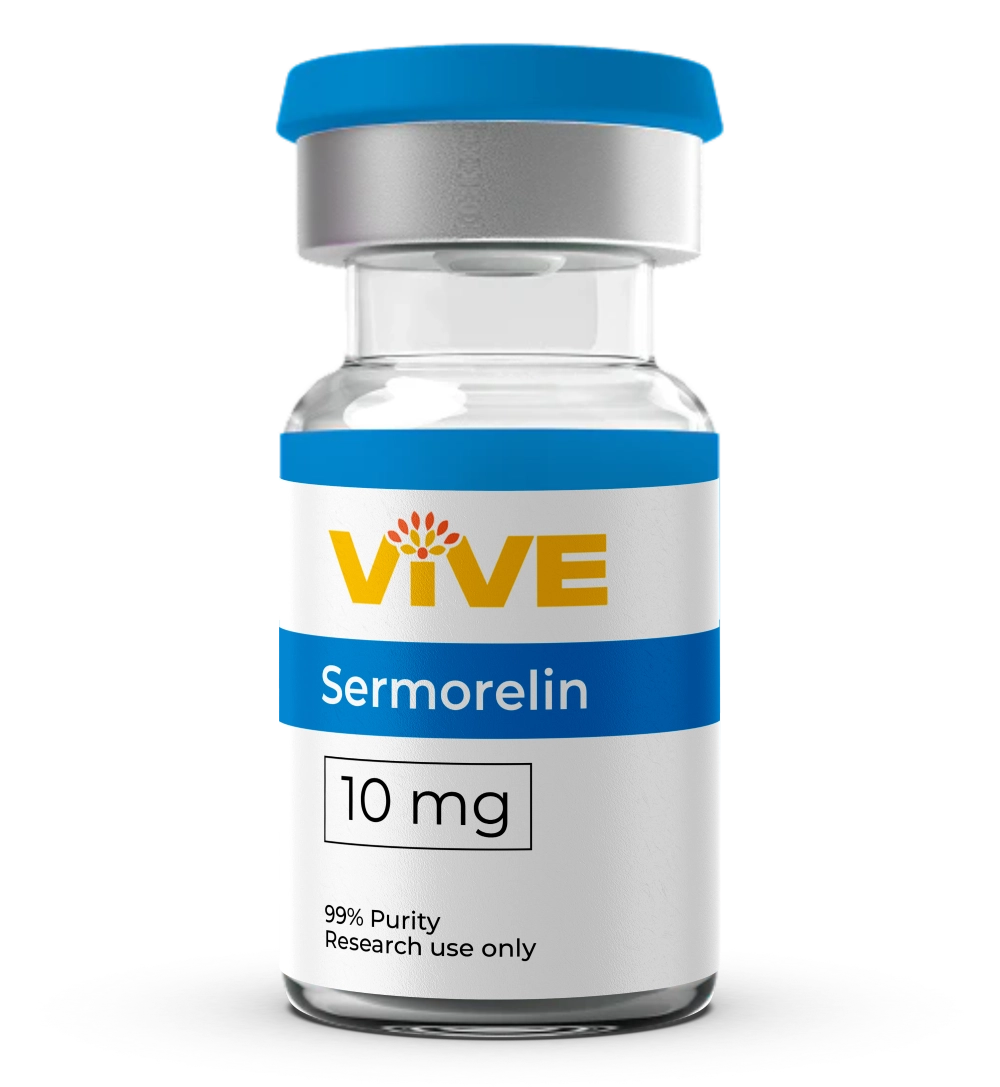
Tesamorelin vs Sermorelin: GHRH Analog Research Comparison
Tesamorelin
Tesamorelin and sermorelin are both GHRH analogs used in growth hormone research, but they differ in length, modification strategy, and pharmacological profiles.
Sermorelin
Both tesamorelin and sermorelin activate the GHRH receptor, but tesamorelin contains the complete GHRH(1-44) sequence with an additional stability modification. Researchers can buy tesamorelin from VivePeptides at ≥99% purity for growth hormone axis research.
| Feature | Tesamorelin | Sermorelin |
|---|---|---|
| Structure | Modified GHRH(1-44)-NH₂ | GHRH(1-29)-NH₂ |
| CAS Number | 218949-48-5 | 86168-78-7 |
| Amino Acids | 44 | 29 |
| Molecular Weight | 5135.89 Da | 3357.88 Da |
| Modification | Trans-3-hexenoic acid at Tyr1 | None (truncated native sequence) |
| Receptor Target | GHRH-R | GHRH-R |
| Full GHRH Sequence | Yes (complete 1-44) | Partial (1-29, minimal active fragment) |
| Research Documentation | Extensively published | Well-established research tool |
RESEARCH STUDIES
Tesamorelin Research Applications & Published Studies
Tesamorelin research spans a substantial body of published literature examining its effects on growth hormone secretion and related metabolic pathways.
Growth Hormone Secretion Studies
Published tesamorelin growth hormone research has documented its effects on GH secretion dynamics in multiple experimental models. Studies have characterized the dose-response relationship of tesamorelin-stimulated GH release, its effects on GH pulse amplitude and frequency, and its interactions with somatostatin-mediated inhibitory feedback. These studies establish tesamorelin as a reliable tool for GHRH receptor pharmacology research.
Lipid Metabolism and Body Composition Research
Tesamorelin research has included investigations of GH-mediated effects on lipid metabolism. Published studies have documented changes in visceral adipose tissue, hepatic fat content, and lipid profiles in animal models following GHRH receptor activation. Falutz et al. (New England Journal of Medicine, 2007) published pivotal research characterizing tesamorelin's effects on trunk fat parameters, contributing to our understanding of GH-mediated lipid metabolism.
Hepatic and Metabolic Pathway Studies
Additional tesamorelin research has explored its effects on hepatic function and metabolic parameters. Studies have examined tesamorelin's influence on liver fat content, insulin sensitivity markers, and lipid oxidation pathways. Stanley et al. (Lancet HIV, 2019) published findings on tesamorelin's effects in research models examining hepatic steatosis parameters, expanding the scope of GHRH analog research.
QUALITY ASSURANCE
Quality & Testing Standards
HPLC & Mass Spectrometry
Every tesamorelin batch undergoes HPLC and mass spectrometry analysis to confirm identity, purity, and molecular weight.
Third-Party Verified
All tesamorelin is independently tested at third-party USA-based analytical laboratories.
≥99% Purity Standard
VivePeptides tesamorelin consistently meets or exceeds ≥99% purity for reliable growth hormone research.
FAQ
Frequently Asked Questions About Tesamorelin
What is tesamorelin used for in research?
What purity is VivePeptides tesamorelin?
How should tesamorelin be stored?
What is the trans-3-hexenoic acid modification in tesamorelin?
Is VivePeptides tesamorelin third-party tested?
BPC-157
Explore More Research Peptides
Gastric pentadecapeptide for tissue biology research
All Peptides → · Vive GLP(R) · NAD+ · GHK-Cu · Selank · Semax · BAC Water
Add To Research Cart
Tesamorelin
99%+ purity · USA lab tested · secure shipping
These products are sold strictly for laboratory and research use only and are not approved for human consumption, diagnosis, or therapeutic treatment. Not for human or veterinary use. These statements have not been evaluated by the Food and Drug Administration, and nothing on this page constitutes medical advice or a health claim.